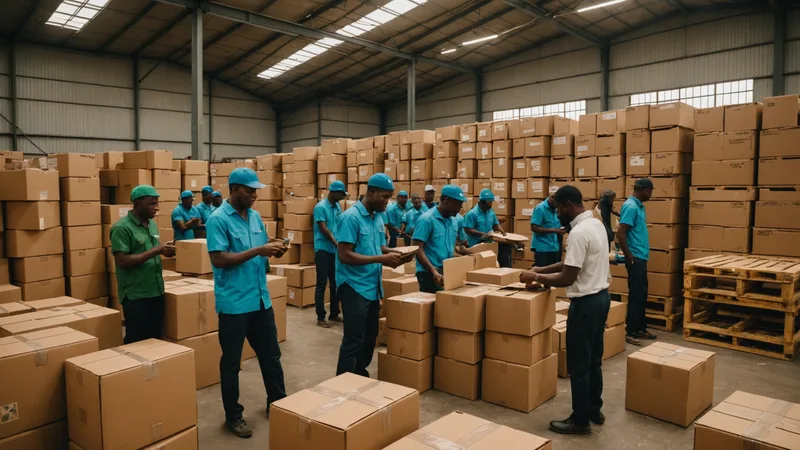
The working capital problem for Nigerian exporters sits at a different point in the trade cycle than most people assume. Everyone talks about the importer's problem — waiting 30 days for a bank LC while goods sit at Apapa and demurrage accumulates. The exporter's problem is less discussed but just as real: the exporter has to fund the entire production and logistics chain before the overseas buyer settles a single naira.
Consider the basic sequence for a Nigerian agro-processor exporting cashews to a buyer in the Netherlands on 60-day open account terms. The processor sources raw nuts from farmers in Ogun or Ondo state — that purchase has to happen weeks before processing. Processing itself takes 10–14 days. Export packaging, fumigation certification, phytosanitary inspection, and loading at Apapa or Tin Can Island takes another week. The vessel transit to Rotterdam takes 20–25 days. The buyer inspects, accepts, and issues payment instruction — which arrives in Nigeria 60 days after the original invoice date. Total time from initial farmer purchase to cash in account: 90–110 days. Total capital tied up during that window: the full cost of goods plus freight, insurance, and certification fees.
For a processor doing ₦15 million per shipment, that is ₦15 million of working capital locked up for three months per order. If they are trying to grow volume and take on two shipments simultaneously, the capital requirement doubles while the revenue timeline stays the same. This is why many capable Nigerian exporters decline orders they could operationally fulfil — not because they lack the production capacity, but because they lack the working capital bridge to fund the gap between purchase and payment.
What Pre-Shipment Finance Actually Covers
Pre-shipment finance is capital advanced to an exporter before goods leave the country, against a confirmed export order. It is distinct from post-shipment finance (invoice discounting or factoring after the goods have shipped and the buyer has received the documents) and from export LCs (which are buyer-initiated instruments).
The specific costs pre-shipment finance is designed to cover vary by commodity and exporter type, but the core categories are consistent:
- Raw material procurement: For manufacturers and processors, the single largest pre-shipment cost. Paying farmers or raw material suppliers before production begins.
- Processing and production costs: Labour, energy, packaging, and equipment time allocated to the specific export order.
- Export certification fees: Phytosanitary certificates (for agricultural commodities), NAFDAC export clearance (for food and pharmaceutical products), Standards Organisation of Nigeria (SON) product certification where applicable, NEPC export registration fees.
- Pre-shipment inspection: Many international buyers require SGS or Bureau Veritas pre-shipment inspection; this cost falls on the exporter unless specifically negotiated otherwise.
- Freight and insurance to port of loading: Moving finished goods from factory to Apapa or Tin Can Island, and marine insurance covering that leg.
- Port charges and freight booking: Container booking deposits and initial freight charges required to secure vessel space.
What pre-shipment finance does not cover is the full freight cost to destination and post-shipment trade costs — those are typically handled through separate post-shipment facilities or directly from the buyer's payment. The logic is that once goods are loaded and the bill of lading is issued, the financing risk profile changes significantly: the exporter has a negotiable transport document that represents the goods, and the transaction has moved from production risk to payment risk.
The NXP and Its Role in Export Financing
Before an exporter can export goods from Nigeria, they are required to file a Nigerian Export Proceeds (NXP) form — the export equivalent of the Form M that importers must file. The NXP is submitted through a licensed bank (Authorised Dealer) and registers the expected export proceeds that will flow back to Nigeria in foreign currency. CBN regulations require that 100% of export proceeds be repatriated — with the exporter retaining a portion for direct costs and the remainder surrendered to the FX market at the prevailing rate.
The NXP is important for pre-shipment finance for two reasons. First, it establishes the formal existence of an export transaction and creates a paper trail that lenders can verify. Second, the expected USD proceeds documented in the NXP serve as the primary repayment signal for the facility — the exporter will receive FX when the buyer pays, which converts to naira and services the pre-shipment loan. Without a clean NXP filing, the lending case becomes much harder to construct.
We check NXP filing status as part of our document review process. An exporter who has an active confirmed purchase order but has not yet filed an NXP can still apply — we note the pre-filing status and factor that into timing. But exporters who arrive with a clean NXP already registered, a confirmed purchase order from a verified buyer, and a proforma invoice that matches the NXP details are in the strongest position for rapid approval.
What Documentation Trade Lenda Requires for Export Finance
The document set for pre-shipment export finance is different from the import finance document set. Here is what we review:
The Export Purchase Order or Offtake Agreement
This is the foundational document. We need to see a confirmed, signed purchase order (or a binding offtake agreement) from the overseas buyer, specifying: commodity, quantity, unit price, total value, delivery terms (typically CIF or FOB with named port), payment terms, and the buyer's company details. A WhatsApp conversation is not sufficient. A formal purchase order on the buyer's letterhead, signed or with a confirmatory email from the buyer's verified business domain, is the minimum.
We have seen cases where an exporter has a verbal commitment from a buyer and is looking for pre-shipment finance to begin production. We understand the commercial reality — buyers sometimes confirm orders informally first. But we cannot advance capital against verbal commitments. Our standard is a written purchase order, and we encourage exporters to push for this before approaching us so there is no delay in application processing.
CAC Certificate and BVN
Standard identity verification. The exporting entity must be a registered Nigerian business. We cross-reference the CAC number with the CAMA registry and the BVN-linked business account through which we will disburse and expect repayment. This step typically takes under 10 minutes on our platform.
NXP Form (Filed or In-Progress)
As described above, the NXP establishes the formal export transaction. If filing is in progress, we note the status and request the filed NXP number as soon as it is available. We do not disburse before an NXP has been filed for the specific transaction we are financing.
NEPC Export Certificate
The Nigerian Export Promotion Council requires exporters to register and obtain an export certificate. This is a one-time registration, not a per-shipment document, but we need to confirm active NEPC status. Exporters who have not registered with NEPC cannot legally export and are therefore not eligible for our pre-shipment facility.
Product-Specific Certifications
This varies by commodity. Agricultural exports require phytosanitary certificates from the Federal Ministry of Agriculture. Processed food exports typically require NAFDAC clearance. Mineral exports require documentation from the Nigerian Upstream Petroleum Regulatory Commission or relevant mining authority. We check what certifications are applicable to the specific commodity and confirm the exporter has active certification status before advancing funds.
Buyer Verification
We run a buyer reliability check on the overseas buyer — payment history where data exists, country risk profile, and the structural terms of the purchase order. This is detailed in our separate piece on buyer reliability scoring. For export finance purposes, a buyer we cannot verify at all (no digital presence, no trade references, no identifiable business registration in their home country) is a significant yellow flag regardless of the strength of the exporter's own profile.
Advance Rates and Tenor for Export Finance
Our standard pre-shipment export finance advances up to 70–80% of the confirmed purchase order value in naira equivalent at the time of disbursement. We do not advance 100% because we want the exporter to maintain skin in the game — if there is a production shortfall or quality dispute, the exporter needs to have sufficient stake in the outcome that they do not walk away from the transaction.
Tenor is set to align with the buyer's payment terms plus a buffer. If a buyer has 60-day open account terms and the production and shipping cycle takes 30 days, we would typically set a 100-day tenor with repayment expected from the buyer proceeds received by the exporter. We build in a 10–15 day buffer beyond the expected payment date to account for normal settlement delays.
Pricing for our export pre-shipment facilities runs 3.0–5.0% of the facility amount per tenor, depending on buyer profile, corridor, commodity, and the exporter's own risk score. This is at rates.html if you want the full current schedule.
What Happens If the Buyer Does Not Pay
This is the question every exporter should ask before taking any pre-shipment facility, from any lender. We are direct about it: if the overseas buyer defaults on payment, the financing obligation does not disappear. The exporter remains liable for repayment of the facility regardless of whether they were paid by the buyer.
We are not saying this to be harsh — we are saying it because some exporters approach pre-shipment finance with the implicit assumption that if the buyer fails to pay, the lender bears the loss. That is not how pre-shipment finance works. It is how credit insurance works. We recommend that exporters taking large export orders consider taking out export credit insurance — either through NEXIM Bank (Nigeria Export-Import Bank, which operates specific export credit guarantee programmes) or through private insurers. If a buyer default would genuinely threaten the exporter's business, the cost of credit insurance is worth the protection.
What we can do is structure facilities in ways that reduce buyer default risk — shorter tenors, buyer confirmation requirements, and the buyer reliability scoring described above. These are risk mitigations, not risk eliminations.
Getting Your First Application Right
The single most common reason export finance applications take longer than necessary is document incompleteness on arrival. The NXP is not filed. The purchase order is missing the buyer's signature. The NEPC certificate has lapsed. The commodity certifications cover a different product category than what is being shipped.
Before submitting to Trade Lenda, run through this checklist: confirmed signed purchase order from buyer, CAC certificate of your business, BVN-linked business account details, NXP filing reference, active NEPC export certificate, relevant commodity certifications, and buyer company details (legal name, registration country, and website or other verifiable presence). If all of this is in order when you submit, our AI model runs the risk assessment in under 30 minutes and our underwriter has everything they need to make a same-day decision.
The export opportunity is real. The capital to fund it should not be the reason you turn orders down.