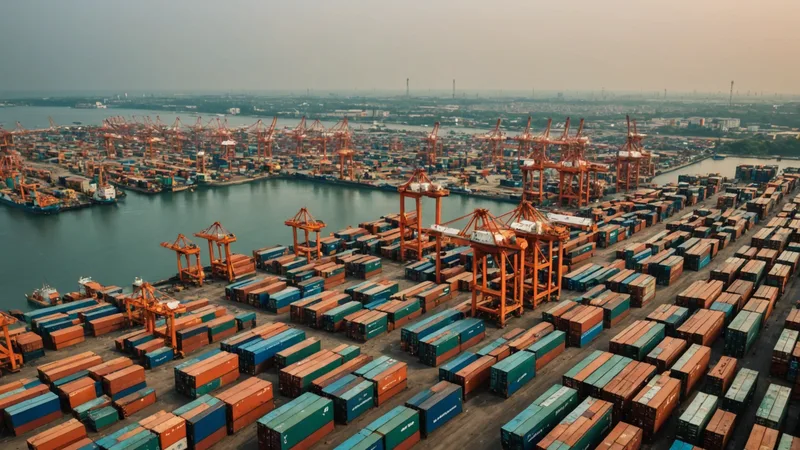
The Apapa–Cotonou corridor is one of the busiest trade arteries in West Africa, and it is also one of the least formally documented. Goods flow in both directions — containerized imports arriving at Apapa destined for re-export to Benin Republic, Togo, and beyond; agricultural commodities and manufactured goods moving through Cotonou as an informal gateway into Nigerian markets. The corridor handles significant formal and informal trade volume, and the traders who work it routinely face capital timing mismatches that conventional finance is badly equipped to solve.
This is not an abstract market analysis piece. We have looked at this corridor closely because our clients operate on it, and the specific risk and timing characteristics of Apapa–Cotonou trade are a meaningful part of how we structure working capital advances for traders who move goods along this route.
Understanding the Corridor's Two-Directional Trade Structure
The conventional mental model of the Apapa–Cotonou corridor is Nigerian imports coming in through Apapa that then leak west into Benin Republic through informal channels. That is part of the picture but not all of it. The corridor actually runs two distinct trade flows that require different finance structures.
Lagos as the primary port of entry for West African imports
Apapa and Tin Can Island are the largest port complexes in West Africa by throughput capacity. For importers across Benin Republic, Togo, Niger, and landlocked Burkina Faso, importing via Nigerian ports — particularly for containerized cargo from China, India, and Southeast Asia — can be faster and cheaper than routing through Cotonou, Lomé, or Tema, depending on the commodity and the period. Cotonou's port has improved significantly over the past decade, but Lagos still handles significantly larger volumes and has more direct carrier services from Asia.
This creates a trade structure where Nigerian traders import goods through Apapa on behalf of, or jointly with, Beninois or Togolese commercial partners, and the goods are then transported by road through the Lagos–Badagry–Cotonou corridor. This is largely formal trade — documented imports, legitimate NCS clearance — that then crosses the land border under ECOWAS trade rules.
Cotonou as a parallel import channel into Nigeria
The reverse flow is what generates more controversy but is equally real economically. Goods imported through Cotonou — which has historically had lower import duties on certain categories, particularly electronics, motorcycles, and used vehicles — are transported by road into Nigeria through Seme border crossing (or through informal crossing points) to serve Nigerian consumer demand for cheaper alternatives to goods cleared through Apapa with full Nigerian duties applied. This trade has existed for decades and is a structural feature of the corridor, not a recent development.
For our purposes as a trade finance provider, we are primarily concerned with the formal Lagos-side component — goods that move through NCS with proper documentation. The informal side of the corridor is economically real but is not what Trade Lenda can finance.
The Timing Mismatch That Creates Capital Problems
Cross-border traders on the Apapa–Cotonou corridor face a capital timing problem that is structurally more complex than a straightforward Lagos importer. Here is the typical sequence:
A Lagos trader imports electronics — say, a consignment of air conditioning units from Guangzhou — with the intent of moving a portion for domestic sale and a portion onward to buyers in Cotonou. The goods arrive at Apapa. Clearance takes 7–10 days. Transportation to Cotonou via Seme takes an additional 2–4 days (assuming no border delays, which is optimistic). The Beninois buyer takes 15–30 days to pay after taking delivery. Total time from port arrival to payment receipt: 25–45 days at best.
If the trader funded the import with a 45-day working capital advance, the repayment clock started ticking at the advance date — which may have been before vessel arrival, meaning the 45-day window is already 5–10 days consumed when goods clear. A 45-day tenor that sounded generous at application time can feel very tight when cross-border transport, border delays, and buyer payment timing are stacked up against each other.
The specific variable that makes this corridor harder to model than pure Lagos domestic trade is the border crossing. Seme and other land border crossing points along the corridor have historically been subject to periodic closure, hours restrictions, congestion, and informal fee demands. Any of these adds days to the clearance-to-payment cycle. Traders working this corridor need either longer tenor finance or significant cash buffer to absorb transit delays.
Risk Factors Specific to the Corridor
Border closure and restriction risk
Nigeria has periodically closed its land borders for economic or security reasons. The most significant recent instance was the 2019–2020 border closure, which severely disrupted Apapa–Cotonou trade for over a year. While that specific episode is past, traders on the corridor need to price in the possibility of short-notice disruptions that delay final delivery and payment. This is a real risk that affects tenor decisions in our model — we treat corridor cross-border trades with slightly longer tenor requirements than equivalent domestic transactions.
Transit documentation complexity
Moving goods from Apapa to Cotonou requires Nigerian customs export documentation in addition to the import documentation. The ECOWAS Transit Declaration (formally the C-Declaration under ECOWAS trade protocols) is required for goods transiting through Nigerian territory to Benin Republic. Traders who are not careful about this documentation can find goods detained at Seme because the transit documents do not correctly match the NCS import clearance records. Document mismatch at the border is one of the most common delay causes on this corridor, and it is entirely preventable with proper documentation practice.
FX and payment currency risk
Nigerian Naira and CFA Franc do not have an efficient direct exchange mechanism. Traders settling cross-border transactions on the Apapa–Cotonou corridor typically use USD as an intermediary, converting from CFA to USD to Naira (or vice versa) through informal money changers at the border or in Lagos's Bureau de Change market. The Naira–USD–CFA chain means that Naira devaluation events directly affect the real value of cross-border receipts. A trader expecting ₦15M from a Cotonou sale based on pricing agreed six weeks earlier may receive ₦13.2M if Naira has strengthened against the dollar while CFA moved differently. This FX exposure is real and is not hedged by most SME traders.
Commodity-specific risk on the corridor
Not all goods are equally suited to corridor trade. High-value, low-volume commodities (electronics, pharmaceuticals, branded consumer goods) are better candidates for the formal corridor than bulk commodities (cement, steel, agricultural bulk) where logistics cost erodes the price differential that makes cross-border trade profitable. We have seen corridor traders attempt to finance large-volume bulk commodity movements that looked profitable on paper but failed when actual transport costs, border fees, and buyer payment delays were factored in. The unit economics need to be stress-tested before committing capital.
How Trade Lenda Structures Capital for Corridor Trades
When we receive a trade finance application from a trader working the Apapa–Cotonou corridor, we apply a few specific adjustments to our standard underwriting approach.
First, we ask for the full transaction structure: where is the final buyer, what are the payment terms with that buyer, and what is the realistic transport-to-payment timeline including border transit? A standard 45-day tenor may not fit. For corridor trades where the final buyer is in Cotonou or beyond, we often structure 60–75 day tenors to accommodate the extended cycle.
Second, we apply a corridor transit risk flag in our scoring model. Trades that route through Seme or other land border crossings get a slightly elevated risk score relative to equivalent domestic Lagos trades, reflecting the additional timing and documentation variables. This does not automatically disqualify corridor trades — it affects the advance amount as a percentage of invoice and the tenor offer.
Third, we look carefully at the overseas buyer's payment history for export-side corridor trades. If a Lagos trader is selling on credit to a Cotonou buyer, the Cotonou buyer's payment reliability is a significant variable in our risk assessment. For new buyer relationships, we require more conservative advance-to-value ratios until a payment track record is established.
What the Corridor Cannot Support Right Now
We are not saying Apapa–Cotonou trade is too risky to finance. We are saying it is more complex than pure domestic import finance, and the finance structure needs to account for that complexity honestly. There are specific sub-categories of corridor trade we will not currently finance:
- Trades where the final buyer is informal and payment is made in cash at the border with no documentation
- Trades where the commodity is in a category subject to Nigerian import prohibition (which includes several categories that are commonly moved through informal border channels)
- Trades where the transit documentation sequence cannot be confirmed in advance
- First-time corridor traders with no NCS export or transit history to verify
These limitations are not arbitrary. They reflect situations where our model does not have sufficient signal to underwrite confidently, and advancing capital into an ununderwritten trade serves neither the trader nor Trade Lenda.
The Capital Gap That Persists on This Corridor
The Apapa–Cotonou corridor has a structural underfunding problem. Nigerian commercial banks are almost entirely uninterested in financing cross-border corridor trade below the level of large logistics companies. The traders who actually move the goods — Lagos-based importers operating ₦20M–₦200M annual cross-border volumes — are too small for the banks' trade finance desks and too complex for simple invoice discounting products.
Alternative lenders, including Trade Lenda, are filling part of this gap. But the honest position is that we are at early stages of building the data infrastructure to underwrite corridor trades with the same confidence we have for pure Lagos domestic import finance. The NCS data on cross-border transit is less complete than the import clearance data. Buyer payment behavior data for Cotonou buyers is thin. We are building this knowledge base trade by trade, and our capacity to serve corridor traders well will improve as the data improves.
If you are an active trader on the Apapa–Cotonou corridor and want to discuss your specific trade structure, reach out to our team directly. Corridor trades benefit from a direct conversation more than a standard application — the transaction complexity means we want to understand your specific situation before proposing a financing structure.